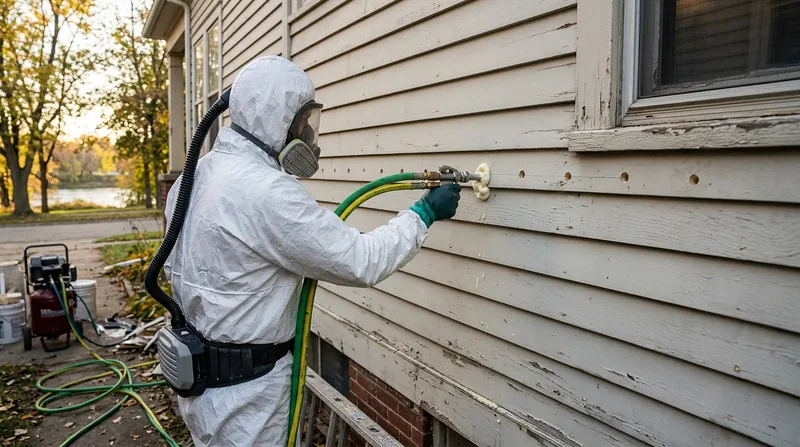




Wall & Injection Foam Insulation in Waterloo fills hollow wall cavities in the early-1900s balloon-framed homes that line Waterloo's older neighborhoods along the Cedar River and throughout Black Hawk County. These homes were built with air gaps between the inner and outer wall studs, and decades of settling have left them drafty and cold through the long heating season. Injection foam reaches into those cavities without opening finished walls, stopping the winter air leaks that drive heating bills higher every year. Unlike blown-in attic insulation or spray foam applied to exposed surfaces, wall injection is a retrofit method designed for homes where the walls are already closed and the rooms are occupied. We've been helping Waterloo homeowners seal these cold spots since 2015, and the results are measurable: warmer rooms, lower drafts, and energy bills that reflect the work we do.
Why Wall & Injection Foam Insulation Matters in Waterloo's Older Homes
Waterloo's housing stock tells a story of three building eras, and the oldest homes carry the biggest heating penalty. Early-1900s balloon-framed construction in Waterloo and Cedar Falls was built with hollow wall cavities that were never insulated. Over time, settling, air currents, and weather have left those cavities nearly empty. A single-pane window or a drafty exterior wall in January can make a room 5 to 10 degrees colder than it should be, and the furnace runs harder to compensate. Wall injection foam fills those gaps with closed-cell or open-cell polyurethane without disturbing plaster, drywall, or finished surfaces. The long, hard winters in IECC climate zone 6A mean that every heating season compounds the cost of uninsulated walls.
- Hollow cavities in balloon-framed walls lose heat continuously through the winter heating season.
- Injection foam seals those cavities from the inside without opening finished walls or ceilings.
- The method works on homes where the exterior is stucco, brick, or siding and the interior is plaster or drywall.
- Cold basements and rim joists often work together with cold walls, so a complete retrofit may include rim and band joist insulation as well.
Homeowners across Waterloo, Cedar Falls, and Evansdale who have had their walls injected report noticeably warmer rooms and lower drafts within days of the work.
Key info: Waterloo's older neighborhoods near the Cedar River have the highest concentration of balloon-framed homes. These houses are the best candidates for wall injection because the cavities are accessible and the walls are often in good condition. A home built before 1920 in Waterloo is very likely to benefit from this retrofit.
For permitting and regulatory questions specific to your Waterloo address, the City of Waterloo Building Department can advise on any local requirements for insulation work on your property.
How Wall & Injection Foam Insulation Works in Waterloo Homes
Injection foam insulation is a measured, controlled process that begins with a site inspection and a clear understanding of the wall cavities we are filling. We drill small access holes (typically 1 to 1.5 inches) in the exterior or interior wall, depending on what makes sense for your home and what the building code allows at your address. We then inject closed-cell or open-cell polyurethane foam into the cavity, filling it completely. The foam expands slightly and cures into a solid, continuous thermal and air barrier. Once cured, we patch the access holes. The entire process is non-invasive and leaves the room livable during and immediately after the work.
- We inspect the wall cavity using a borescope or thermal imaging to identify the best access points and confirm the cavity is dry and free of contamination.
- We drill small access holes in a location that is easy to patch and invisible once finished (often along the rim or behind trim).
- We inject foam at a controlled rate and pressure, filling the cavity from bottom to top to ensure complete coverage and no voids.
- The foam cures in 24 to 48 hours, and we patch the access holes with foam-compatible sealant and matching trim.
- A finished wall injection job is invisible from inside the room and requires no interior demolition or reconstruction.
The process is fastest on homes with accessible exterior walls and simplest on walls that are straight and free of obstructions like plumbing or electrical.
Local example: A 1910 home in Waterloo with a cold south-facing wall and a drafty living room is a typical injection candidate. After we inject the cavity, the room stays 3 to 5 degrees warmer on the same thermostat setting. The homeowner notices the difference immediately and the heating bill reflects it by the next billing cycle. The entire job takes one day, and the room is ready to use the same evening.
For homes where the walls are already exposed (such as during a renovation or in a basement), open-cell spray foam applied directly to the wall cavity may be a faster and more cost-effective option.
Wall & Injection Foam Insulation Methods and Materials
| Approach | Description | Best for |
|---|---|---|
| Closed-Cell Injection Foam | Higher R-value per inch (R-6 to R-7), low permeability, provides both thermal and vapor barrier. Cures firm and rigid. | Exterior walls in cold climates, walls that must resist moisture, cavities where space is tight and maximum R-value is needed. |
| Open-Cell Injection Foam | Lower R-value per inch (R-3.5 to R-4), more permeable, cures soft and spongy. Easier to install in tight cavities and less expensive. | Interior walls, cavity fill where R-value is secondary to cost, sound dampening, walls in moderate climates. |
| Two-Component Polyurethane System | Isocyanate and polyol mixed at the nozzle in precise ratio, injected into cavity at controlled pressure. Manufacturer spec is non-negotiable. | All wall injection work. Correct ratio and temperature control determine final R-value, density, and cure time. |
| Injection Pressure and Rate Control | Foam is injected slowly and at low pressure to fill the cavity completely without cracking plaster or blowing out studs. Over-pressure is a sign of poor technique. | Historic homes and homes with plaster walls, any cavity where the integrity of surrounding finishes must be preserved. |
The choice between closed-cell and open-cell for wall injection depends on the wall orientation, the local climate, and whether vapor permeability matters at that location. In Waterloo's cold climate, exterior walls typically call for closed-cell foam because the vapor drive is outward in winter. Interior walls and cavity fills can often use open-cell and save cost. We specify the material and the R-value in every written estimate, so you know exactly what you are paying for before we start.
Wall & Injection Foam Insulation Cost in Waterloo: What to Expect
Wall injection foam in Waterloo typically starts at $2 per square foot of wall cavity filled, and the final cost depends on the size of the wall, the number of access points needed, the type of foam (closed-cell or open-cell), and the accessibility of the work. A single cold exterior wall in a Waterloo home might run $400 to $800. A full retrofit of multiple walls in a larger home could range from $1,500 to $3,500 or more. The cost includes drilling, foam injection, patching, and cleanup, but does not include any plaster or drywall repair beyond the access hole patch. If the wall is wet, contaminated, or has active moisture, we stop and do not proceed until the moisture is resolved.
Several factors move the price up or down:
- Wall size and linear footage determine how much foam is needed and how many access holes we drill.
- Accessibility affects the number of holes and the time required; a wall on the first floor is faster than a wall on the second story.
- Closed-cell foam costs more per board foot than open-cell, so the choice of material shifts the final number.
- Existing insulation or obstructions inside the cavity (old newspaper, debris, or rodent nesting) may require removal before we can inject.
- Historic or delicate finishes on the exterior (original siding, stucco, or brick) may require more care and slower drilling, which increases labor time.
The best way to know the cost for your home is to request a free, no-obligation estimate. We measure the wall, assess the cavity, and give you a written quote with R-value and thickness specs before any work starts. We encourage you to get 2 to 3 estimates from different contractors so you can compare not just price, but the detail and confidence in each proposal.
For a full breakdown of pricing across all our services, including wall injection, visit our pricing page.
What to Look for When Hiring a Wall & Injection Foam Contractor Near Waterloo
Wall injection foam is a specialized trade, and not every spray foam contractor has the equipment, experience, or patience to do it right. When you are comparing contractors near Waterloo, Cedar Falls, Evansdale, Hudson, and Raymond, here are the signs of a professional installer and the red flags to avoid. A written estimate with R-value and thickness specs is the first filter; if a contractor gives you a price without specifying what foam type, what R-value per inch, and how thick the cavity will be filled, move on. A contractor who promises immediate re-entry or a 24-hour cure in cold weather is cutting corners on ventilation or drum temperature. A price far below market with no inspection is a warning sign of poor technique or incomplete work.
- Verify that the contractor is fully insured and can provide a current certificate of insurance on request.
- Ask for references from recent wall injection jobs in Waterloo or nearby, and call them to ask about the quality of the work and whether the contractor was responsive if questions came up after the job.
- Check that the contractor understands the local building code and permitting requirements for your address; Waterloo and Cedar Falls have different rules, so a local contractor knows the difference.
- Confirm that the contractor will provide a written warranty on the workmanship (typically one to three years) and can explain what it covers.
- Ask how the contractor handles a wall that turns out to be wet or contaminated; the right answer is we stop, we do not spray, and we help you fix the moisture first.
A local, independent spray foam contractor with a local address and local plates is positioned to stand behind the work and be reachable if a question comes up months later. National franchises and out-of-state rig-and-run crews can disappear, and the smell, the performance, or the warranty becomes your problem alone.
When you are ready to move forward, contact us for a free estimate or call (319) 349-2560. We are fully insured, we provide written estimates with R-value and thickness specs, and we have been serving Waterloo and Black Hawk County since 2015.
Wall & Injection Foam Insulation in Waterloo: Pricing Guide
| Service | Price | Details |
|---|---|---|
| Wall Injection Foam (Closed-Cell) | Starting at $2.50/sq ft | Higher R-value (R-6 to R-7 per inch), vapor barrier, best for exterior walls in cold climates. Cost varies by wall size and access. |
| Wall Injection Foam (Open-Cell) | Starting at $1.50/sq ft | Lower cost option (R-3.5 to R-4 per inch), suitable for interior walls and cost-conscious retrofits. Price depends on cavity size. |
| Multi-Wall Retrofit (Closed-Cell) | On estimate | Insulating multiple walls in one home often qualifies for volume pricing. Site inspection required to determine linear footage and access. |
| Travel and Mobilization | Included | No separate charge for work within Waterloo and surrounding service areas. All-inclusive pricing from first hole to final patch. |
| Free Written Estimate | No cost, no obligation | Response within 24 hours. Detailed quote includes R-value, thickness, material type, and labor. Call (319) 349-2560 to schedule. |
Indicative pricing, the exact cost depends on square footage, finish, and site access. Free personalized estimate within 24h at (319) 349-2560.


