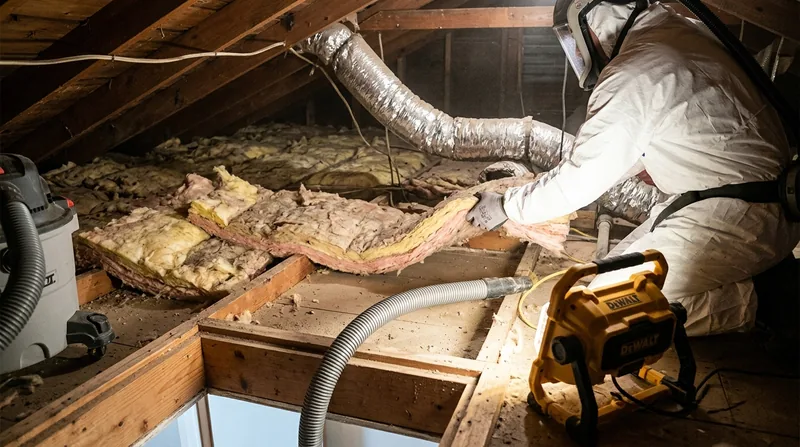




Waterloo's postwar housing stock, scattered across the Cedar Valley from the older balloon-frame neighborhoods along the Cedar River to the newer two-story construction in Hudson and Raymond, carries decades of insulation that has failed in place. Attics in postwar ranches hold fiberglass or cellulose that has settled and compacted, losing R-value and leaving gaps where air leaks straight through the ceiling plane into the conditioned space below. Before insulation removal in Waterloo can make room for a tight spray foam air barrier, that old material has to come out cleanly and safely. We remove settled fiberglass, cellulose, and failed foam from attics, walls, crawl spaces, and rim joists across Black Hawk and Bremer counties, clearing the substrate so new foam can be installed to code and to specification. This is the foundation of every retrofit in a cold climate where the heating season stretches from October through April and air leakage costs money every single day.
Why Insulation Removal Matters in Waterloo's Aging Housing Stock
The homes that dominate the Waterloo market were built in two distinct waves: early 1900s balloon-frame construction near the Cedar River, and postwar ranches scattered across the city from the 1950s through the 1970s. Both eras brought insulation choices that have failed over time. Fiberglass batts compress and settle, cellulose blown into vented attics absorbs moisture and loses R-value, and earlier foam installations sometimes separate from the substrate or off-gas in ways that make them unsafe to leave in place. When the time comes to upgrade to spray foam or to replace failed insulation, the old material must be removed completely. A clean attic deck, a clear rim joist cavity, or an empty wall cavity is the only honest substrate for new foam.
- Settled fiberglass and cellulose lose R-value over decades and compress under their own weight, leaving voids where cold air enters.
- Moisture-damaged insulation in attics and crawl spaces can trap water and create conditions for decay in wood framing.
- Old foam installations that have degraded or separated from the substrate must be removed before new foam is applied over them.
- Removal clears the way for a complete air barrier, ensuring that spray foam can contact the substrate uniformly and cure properly.
- Proper disposal of old insulation keeps fiberglass fibers, cellulose dust, and foam debris out of the living space during the retrofit.
Removing the old insulation is not optional if you want the new system to work. It is the essential first step of every retrofit across Greater Waterloo.
Key info: Postwar ranches in Waterloo often have 4 to 6 inches of compacted fiberglass in the attic, some of it installed before 1980. When that material is removed, homeowners often discover that the attic deck itself is sound and ready for foam. That clarity is why removal is worth doing right.
For guidance on what applies at your address in Waterloo or the surrounding towns, check with your local building department or contact us for a free estimate. We help homeowners understand the removal scope and what comes next.
How We Remove Insulation in Waterloo: Step by Step
Insulation removal is a methodical process that protects your home and the crew. We set up containment to keep dust and debris from spreading into living spaces, remove the old material by hand or with equipment depending on the type and volume, bag it for disposal, and leave the substrate clean and ready for the next phase. For attics, we work systematically across the deck, removing batts or blown-in material and exposing any damage to framing or sheathing so you know what you are starting with. For crawl spaces and rim joists, we extract old foam or batts, inspect the rim band and band joist for moisture or decay, and prepare the cavity for new foam. The end result is a clear, dry, contaminant-free surface.
- We inspect the attic or cavity and assess the type, volume, and condition of the existing insulation.
- We set up plastic sheeting and negative pressure ventilation to contain dust and fibers during removal.
- We remove old batts, blown-in material, or failed foam by hand or with equipment, bagging it as we go.
- We clean the substrate, inspect framing for damage or moisture, and document any issues we find.
- We dispose of the removed material according to local regulations and haul debris from the site.
The whole process typically takes one to three days depending on the size of the space and the volume of material to remove.
Example: A postwar ranch in Waterloo with a 1,200-square-foot attic filled with 6 inches of settled fiberglass usually takes two days to remove completely. A crawl space under a Cedar Falls home with old foam and moisture damage takes one day. We give you a realistic timeline when we estimate the job.
Once removal is complete, the substrate is ready for spray foam insulation or other upgrades. We can coordinate the full retrofit from removal through foam installation and air sealing.
Removal Methods: Choosing the Right Approach for Your Home
| Method | Description | Best for |
|---|---|---|
| Hand removal with containment | Batts or blankets are pulled by hand and bagged in plastic sheeting with negative pressure ventilation to contain fibers. | Fiberglass batts in attics and rim joist cavities; small to medium spaces where access is good. |
| Vacuum extraction | Blown-in cellulose or fiberglass is vacuumed into a collection unit with HEPA filtration, minimizing dust in the home. | Settled cellulose or loose-fill fiberglass in attics; large volumes where hand removal would be slow. |
| Foam removal and disposal | Old spray foam is cut and pulled from the substrate, bagged, and disposed of according to local regulations. | Failed or degraded foam in attics, crawl spaces, or walls; preparation for new foam installation. |
| Substrate inspection and repair | After removal, framing is inspected for moisture damage, rot, or settling; minor repairs are noted for the next phase. | All removal jobs; essential before new insulation is installed to ensure a sound surface. |
The right method depends on the type of insulation, the space being cleared, and your home's layout. We assess the situation on site and recommend the most efficient approach.
Insulation Removal Cost in Waterloo: What to Expect
The cost of insulation removal in Waterloo starts at around $950 for a small attic or crawl space and rises with the volume of material, the difficulty of access, and the type of insulation being removed. Blown-in cellulose in a large attic costs more than hand removal of batts in a smaller space. Crawl spaces with moisture damage or tight access add to the labor. Rim joist cavities are usually smaller jobs and fall at the lower end of the range. We provide written estimates with the square footage, the method we recommend, and a realistic timeline so you know what the removal will cost before we start.
Several factors shape the final price. The size of the attic or space being cleared is the primary driver. The type of insulation (batts, blown-in, foam) determines whether we use hand removal or vacuum extraction. Access difficulty, moisture damage that requires extra care, and local disposal costs all affect the estimate. If framing damage is discovered during removal and needs repair before new insulation can be installed, that work is quoted separately. Getting 2 to 3 estimates from contractors in the Waterloo area is always smart so you can compare methods, timelines, and prices.
For detailed pricing and to schedule a free estimate, visit our pricing page or call us at (319) 349-2560. We respond within 24 hours and provide a firm quote based on an on-site inspection.
Insulation Removal Near Me: What Waterloo Homeowners Should Know When Hiring
Finding a qualified contractor to remove insulation is straightforward if you know what to look for. Start by verifying that the contractor is fully insured and carries liability and workers compensation coverage. Ask for proof of insurance and confirm that it covers insulation removal work. Get written estimates from at least two contractors, and compare not just price but the scope of work, the removal method, the timeline, and what happens to the old material. A contractor who can explain why they are using a specific removal method and who offers a detailed estimate with square footage and R-value specs is showing you the care that matters. References from recent jobs in Waterloo or nearby towns are worth calling. Ask about any permits that may apply at your address. Waterloo building codes govern attic ventilation and thermal barriers in some retrofit situations, so a contractor who knows the local rules and defers to your building department is a safer choice than one who promises to handle everything without asking.
- Verify that the contractor is fully insured with current liability and workers compensation certificates available on request.
- Get written estimates from at least two contractors, comparing scope, method, timeline, and disposal costs.
- Ask for references from recent removal jobs in Waterloo, Cedar Falls, Hudson, or other local towns.
- Confirm that the contractor understands local permitting and building code requirements for your address.
- Check that the contractor explains the removal method clearly and documents any damage or issues found during the work.
Once you have selected a contractor, contact us or any contractor you are considering to confirm the estimate, discuss the timeline, and schedule the work. A professional removal contractor will be reachable before, during, and after the job so you can ask questions and confirm that the work is complete.
Insulation Removal in Waterloo: Pricing Guide
| Service | Price | Details |
|---|---|---|
| Small attic removal (under 800 sq ft) | Starting at $950 | Hand removal of fiberglass batts or small volume blown-in material, containment, and cleanup included |
| Medium attic removal (800 to 1,500 sq ft) | Starting at $1,450 | Vacuum extraction of cellulose or blown fiberglass, containment, disposal, and substrate inspection included |
| Crawl space or rim joist removal | Starting at $850 | Hand removal of batts or old foam from cavities, inspection for moisture and framing damage, containment included |
| Large attic or complex removal | On estimate | Volume over 1,500 sq ft, multiple material types, moisture damage, or difficult access requires on-site assessment |
| Travel | Included | No separate mileage or travel fee within Waterloo and surrounding service areas |
| Free estimate | Free | Written estimate with square footage, method, timeline, and price; response within 24 hours at (319) 349-2560 |
Indicative pricing, the exact cost depends on square footage, finish, and site access. Free personalized estimate within 24h at (319) 349-2560.


