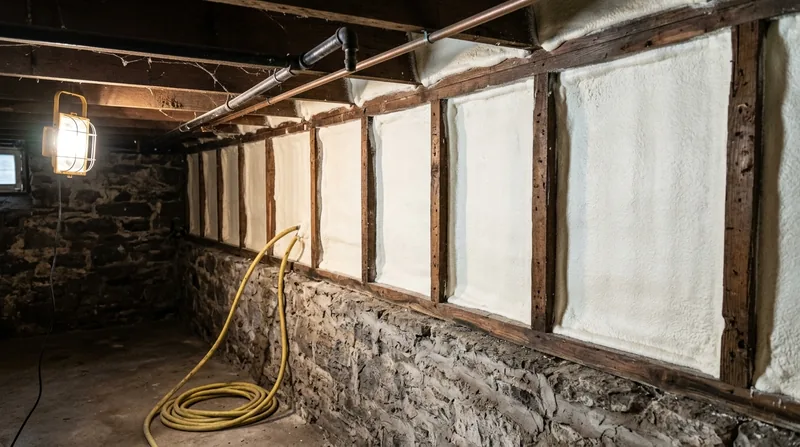




Closed cell spray foam insulation in Waterloo is the high-performance choice for the cold basements, rim joists, and uninsulated garages that dominate the Cedar Valley's housing stock. Waterloo's older neighborhoods along the Cedar River, built in the 1900s with balloon frames and thin rim joists, lose steady heat through air gaps that fiberglass and blown-in insulation simply cannot seal. Postwar ranches scattered across the city add vented attics with settled insulation and ductwork that bleeds heat straight through the ceiling plane. Newer homes in Cedar Falls, Evansdale, and Hudson bring rooms over garages and detached shops that swing in temperature through the year. In climate zone 6A, where winters stretch long and hard, a continuous air barrier is the only answer. Closed cell foam delivers that seal while adding structural rigidity and holding its R-value in the damp conditions common under older homes. We have served Black Hawk and Bremer counties since 2015, and we know the failure points in this region by address.
Why Closed Cell Spray Foam Works in Waterloo's Cold Basements and Rim Joists
Waterloo's foundation walls and rim joists face a specific pressure: warm interior air in winter meets cold exterior surfaces, and moisture condenses at the air barrier. Fiberglass and cellulose absorb that moisture and lose R-value. Closed cell foam sheds moisture, maintains its insulating power, and, because it is rigid, adds bracing to older rim joists that can flex and crack. The high R-value per inch (around 6.5 to 7.0 per inch) means you reach code compliance in less cavity depth, a real advantage in tight basement rim spaces and crawl space headers.
- Closed cell foam resists moisture and holds R-value in the damp basements common under Waterloo's pre-1970 housing stock.
- The rigid structure adds lateral support to older rim joists and band boards that may have settled or cracked over decades.
- High R-value per inch means code compliance in shallow cavities, critical in tight basement rim spaces and crawl space headers.
- Closed cell foam creates an air barrier that stops the heat loss and moisture migration that plague Waterloo's older homes through the long heating season.
These advantages make closed cell the standard choice for any basement or rim joist retrofit across the Cedar Valley.
Key info: A 1920s Waterloo home with a balloon-frame rim joist and no rim insulation can lose 15 to 25 percent of its heating energy through that single path. Closed cell foam seals and braces that joint in one pass. The same applies to a 1950s ranch in Cedar Falls with an uninsulated crawl space header: closed cell rigidity prevents flex and moisture absorption that would fail in a year or two.
For technical detail on how spray foam air sealing works across your whole envelope, see our air sealing page.
How We Install Closed Cell Spray Foam Insulation in Waterloo: The Process
Closed cell installation is precise work. We arrive with our rig and equipment, set up mechanical ventilation in the space (required during cure), and spray the foam in controlled passes to hit the exact thickness and R-value your space needs. We measure every job on site, calculate board footage, and confirm the manufacturer's ratio and drum temperature before we start. Once the foam cures (typically 24 to 48 hours), it is hard, dimensionally stable, and ready for whatever comes next, whether that is a thermal barrier, drywall, or flooring.
- We inspect the substrate (rim joists, band boards, crawl space headers, or basement walls) and note any moisture, rot, or active leaks before we spray.
- We set up mechanical ventilation in the work area to manage fumes during cure and ensure safe re-entry after 24 to 48 hours.
- We spray the foam in passes, controlling thickness and density to hit the R-value and coverage your space needs.
- We verify the manufacturer's ratio and drum temperature on every job so the foam cures correctly and holds its performance.
- We confirm the thermal barrier and ignition barrier requirements that apply at your address (these rules vary by city and are set by your local building code).
Every closed cell job we do includes a written estimate with the R-value and thickness specs spelled out, so you know exactly what you are paying for.
Example: An Evansdale homeowner with a 600-square-foot crawl space and no insulation calls us in September. We inspect the space, find the rim joists are exposed and the header is soft in one corner (we recommend he address that rot first or we walk away). Once he gets that fixed, we spray 2 inches of closed cell on the rim and band, then 4 inches on the header beams. The job takes one day, the foam cures over the weekend, and his heating bills drop in November when the season kicks in hard.
For more on how we handle difficult spaces, see our crawl space insulation page.
| Approach | Description | Best for |
|---|---|---|
| Rim and Band Joist | 2 to 4 inches of closed cell foam sprayed on the rim, band, and header beams, creating a continuous air barrier and structural brace. | Older Waterloo homes with cold basements and heat loss through the foundation perimeter. |
| Basement Wall | Full-depth closed cell foam on interior basement walls, sealing air leakage and resisting moisture in below-grade spaces. | Basements with active air leakage, moisture concerns, or spaces being finished for living or storage. |
| Crawl Space Header and Rim | 4 to 6 inches of closed cell on crawl space headers and rim joists, with rigid foam adding lateral support to older wood members. | Crawl spaces under pre-1980 homes where headers are exposed and moisture control is critical. |
| Garage Walls and Ceiling | Closed cell foam on interior garage walls and ceiling, sealing air leakage and providing thermal separation from the unheated garage. | Garages attached to living space or detached shops in the Cedar Valley that experience wide temperature swings. |
| Metal Building or Barndominium | Closed cell foam sprayed on the interior of metal roof decks and walls, controlling condensation and providing insulation in one pass. | Metal buildings, pole barns, and barndominiums across Black Hawk County where condensation on steel is the dominant failure mode. |
Closed Cell Spray Foam Insulation Cost in Waterloo: What to Expect
Closed cell spray foam in Waterloo typically runs from $1.20 to $1.60 per board foot, depending on the complexity of the space, access, substrate condition, and the thickness you need to reach your R-value target. A rim and band joist job on a 1,200-square-foot older home might run $2,500 to $4,500. A full crawl space with 4 to 6 inches on the header and rim can range from $3,000 to $6,000. A garage retrofit or metal building interior will land somewhere in that range, adjusted for the wall and ceiling square footage you are covering. The real cost driver is not the foam itself but the substrate condition, access to the space, and the R-value you need.
If the rim joist has active moisture or soft rot, we stop and refer you to a contractor who handles structural repair. If the crawl space has standing water, we do not spray. If access is tight or the space is heavily obstructed, setup time and working room push the labor cost up. If you need only 2 inches to seal air leaks in a tight rim, the job is smaller and cheaper than a full 6-inch crawl space retrofit. Get 2 to 3 written estimates so you can compare not just price but R-value specs, thickness per pass, and warranty terms. A cheap estimate with no R-value and no thickness detail is the first sign of poor work.
For detailed pricing and a breakdown by job type, visit our pricing page.
Closed Cell Spray Foam Insulation Near Me: What Waterloo Homeowners Should Know When Hiring
Before you hire any spray foam contractor in Waterloo or the surrounding areas, verify three things: insurance, references, and a written estimate with R-value and thickness. Ask to see proof of general liability and workers compensation insurance, and confirm the carrier is active (do not accept a certificate that is dated or vague). Call two or three previous customers in your city and ask whether the job stayed on schedule, whether the smell was managed, and whether the foam is holding up. Check whether your city requires a permit for insulation work at your address by calling your local building department. Some Waterloo neighborhoods have HOA rules that govern exterior work on metal buildings or accessory structures, so verify those before you commit.
- Ask the contractor for a written estimate that specifies the R-value per inch, the total thickness in each zone, and the board footage being sprayed.
- Confirm the contractor is fully insured and ask to see proof of general liability and workers compensation coverage.
- Call at least two references in your area and ask whether the work stayed on schedule and whether the installation quality was sound.
- Check with your local building department to confirm whether a permit is required and whether there are thermal barrier or ignition barrier rules that apply to your space.
- If your property is in an HOA or a master-planned community, verify that the work (especially on exterior metal buildings or sheds) does not violate architectural covenants.
The contractor who can answer these questions clearly and provides a detailed written estimate is the one worth hiring.
When you are ready to move forward, contact us for a free estimate or call (319) 349-2560. We respond within 24 hours and provide a written quote with full R-value and thickness specs before you decide.
Closed Cell Spray Foam Insulation in Waterloo: Pricing Guide
| Service | Price | Details |
|---|---|---|
| Rim and Band Joist Retrofit | Starting at $1.20/board ft | 2 to 4 inches of closed cell on rim, band, and header beams. Price moves up with substrate rot or soft wood requiring repair first. |
| Crawl Space Header and Rim | Starting at $1.30/board ft | 4 to 6 inches of closed cell on crawl space headers and rim joists. Tight access or heavy obstruction increases labor time and cost. |
| Basement Wall or Garage Retrofit | Starting at $1.25/board ft | Full-depth closed cell on basement walls or garage interiors. Larger square footage lowers per-board-foot cost; difficult access raises it. |
| Metal Building or Barndominium | Starting at $1.35/board ft | Closed cell on interior metal roof decks and walls for condensation control. Steeper roof pitch and larger area bring economies of scale. |
| Travel and Setup | Included | No mileage fee or travel surcharge in Waterloo, Cedar Falls, Evansdale, Hudson, and surrounding areas across Black Hawk and Bremer counties. |
| Free Written Estimate | No charge | Includes on-site inspection, R-value and thickness calculation, board footage, and pricing. Response within 24 hours at (319) 349-2560. |
Indicative pricing, the exact cost depends on square footage, finish, and site access. Free personalized estimate within 24h at (319) 349-2560.


