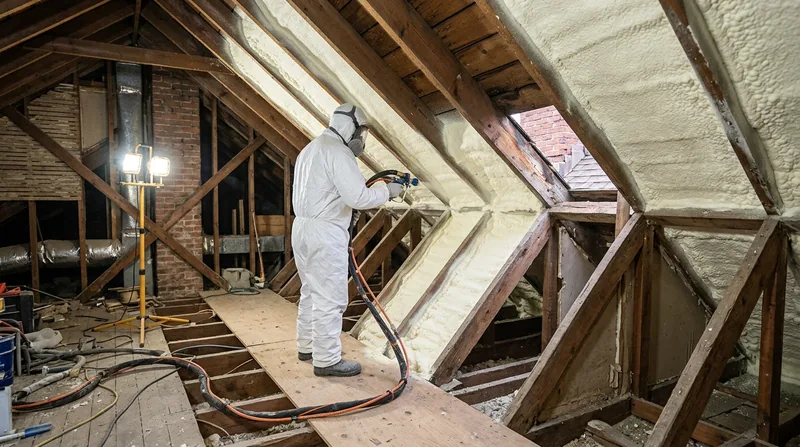




Insulation Replacement & Re-Insulation in Waterloo is the practical answer for older homes and buildings where original insulation has settled, failed, or been damaged by moisture and air leakage. Waterloo's housing stock spans three distinct eras: early-1900s balloon-frame homes along the Cedar River with uninsulated rim joists and cold basements, postwar ranches with vented attics and thin settled insulation, and newer construction in Cedar Falls, Evansdale, and Hudson with rooms over garages and temperature-sensitive spaces. This is IECC climate zone 6A, where long, hard winters drive moisture outward from warm living space into cold attics and wall cavities, causing condensation and heat loss that a blower door test will expose. When insulation fails, energy bills climb and comfort drops across the entire home. We remove failed insulation and replace it with spray foam sized for zone 6A conditions, sealing the gaps that cost you heat all winter long.
Why Insulation Replacement Matters in Older Waterloo Neighborhoods
Homes built before 1970 in the older Waterloo neighborhoods near the Cedar River often have insulation that has settled, compacted, or absorbed moisture over decades. Fiberglass batts shrink and lose R-value when they get wet; blown-in cellulose settles and leaves gaps at the top of walls and around rim joists. Postwar ranches across Black Hawk County have attics where original insulation is now just a thin layer over the ceiling plane, and ductwork leaks conditioned air straight through uninsulated cavities. When you heat your home in winter, that warm air finds every path to the cold outside, and a failed insulation layer is the biggest leak of all. A complete insulation removal and replacement with spray foam closes those gaps, controls moisture at the source, and stops the air leakage that a blower door test reveals.
- We remove old, settled, or wet insulation from attics, walls, and crawl spaces without leaving gaps or contamination behind.
- Spray foam adheres to wood, metal, and concrete, filling voids that fiberglass and blown-in products cannot reach.
- Closed cell foam in attics and walls provides both insulation and air sealing in a single pass, eliminating the need for separate barriers.
- Open cell foam in attics offers a lower cost option when the primary goal is R-value and sound dampening without the high density of closed cell.
- We size every job for zone 6A heating loads, meaning thicker foam in attics and full coverage of rim joists and basement band joists where heat loss is fastest.
Replacing failed insulation is not optional in a climate this cold; it is the foundation of energy efficiency and comfort.
Key info: Homes in Waterloo and Cedar Falls built between 1950 and 1980 typically have attics with 2 to 4 inches of settled insulation rated R-7 to R-12. Zone 6A code calls for R-38 to R-49 in attics. That gap costs you 75 percent of the heating energy that should stay inside your home.
For more on the removal process, see Insulation Removal in Waterloo.
How Insulation Replacement Works: Our Process in Waterloo
Insulation replacement starts with a thorough inspection and a blower door test to find where air is leaking and where insulation has failed. We then remove all old insulation, inspect the substrate for moisture and damage, and repair any leaks or structural issues before foam is sprayed. The replacement is sized to your home's heating load, local code requirements, and the specific cavities being filled. Every pass of foam is applied at the manufacturer's ratio and temperature, with mechanical ventilation running during cure to manage off-gassing. We document thickness and R-value on every job so you have proof of what was done.
- We inspect the attic or wall cavity for moisture, mold, pest damage, or structural issues before any foam is applied.
- Old insulation is removed completely and disposed of according to local waste regulations.
- The substrate (wood, metal, concrete) is cleaned and allowed to dry if any moisture is present.
- We apply spray foam in controlled passes, maintaining thickness and density per the manufacturer specification for your climate zone.
- Mechanical ventilation runs during and after application to manage VOC emissions; re-entry is safe after 24 to 48 hours.
- We provide a written estimate with R-value, thickness, and square footage so you know exactly what you are paying for.
This method ensures that insulation replacement stops both heat loss and air leakage in a single, durable installation.
Real example: A 1960s ranch in Hudson with a 1,200 square foot attic had 3 inches of settled fiberglass rated R-9. After removal and replacement with 6 inches of closed cell foam (R-38), the homeowner's winter heating season showed a typical 20 to 25 percent reduction in energy use. The blower door test dropped from 9,200 CFM50 to 6,800 CFM50, confirming that air sealing alone accounted for 2,400 CFM of the total leakage.
Learn more about Attic Spray Foam Insulation and how sealed attics perform in zone 6A winters.
Insulation Replacement Methods: Closed Cell vs. Open Cell vs. Blown-In
| Approach | Description | Best for |
|---|---|---|
| Closed Cell Spray Foam | High-density foam (1.5 to 2 lbs/cf) that creates a rigid air barrier and vapor barrier. R-value of 6 to 7 per inch. Requires 15-minute thermal barrier (drywall, paint) or ignition barrier per code. | Attics in zone 6A, sealed roof decks, rim and band joists, crawl spaces with moisture risk, metal buildings and garages where condensation control is critical. |
| Open Cell Spray Foam | Lower-density foam (0.5 to 0.75 lbs/cf) that is softer, more flexible, and allows drying. R-value of 3.5 to 3.7 per inch. Requires ignition barrier (paint, drywall) per code. | Attics in cold climates where cost is a priority and ventilation is adequate, interior walls for sound dampening, any cavity where the foam will not face condensation risk. |
| Blown-In Insulation (Top-Up) | Cellulose, fiberglass, or mineral wool blown into attic cavities. Settles over time. No air sealing. Cost-effective for adding depth to existing sound insulation. | Attics where original insulation is in good condition and only needs depth added, or where budget is the primary constraint and air sealing is already adequate. |
| Wall and Injection Foam | Low-pressure foam injected into closed wall cavities of older homes without removing drywall. Fills voids left by failed batts or original construction gaps. Closed cell only. | Retrofit of pre-1980 balloon-frame and platform-frame homes in Waterloo and Cedar River neighborhoods where wall cavities are uninsulated or partially insulated. |
The choice between these methods depends on your climate, the substrate, moisture risk, and whether air sealing is part of the job. In zone 6A, closed cell foam in attics and crawl spaces is the standard because it controls both heat loss and moisture. Open cell is the cost-friendly option when the attic is already vented and the goal is R-value alone. Blown-in works only if the existing insulation is sound and only needs topping up. Learn more about closed cell spray foam and why it is the choice for moisture-prone climates.
Insulation Replacement & Re-Insulation Cost in Waterloo: What to Expect
Insulation replacement pricing depends on the square footage of the area being insulated, the type of foam (closed cell or open cell), the thickness required for your climate zone, and the condition of the substrate before foam is applied. A typical attic replacement in a Waterloo ranch or colonial home runs from $2,800 to $6,500, depending on size and foam type. Rim joist and basement band joist insulation in a full basement typically runs $1,200 to $2,400. Wall injection foam in a pre-1980 home with balloon framing can range from $3,500 to $7,000 for a whole-home retrofit, depending on wall length and cavity accessibility.
Several factors move the price up or down. A larger attic (over 1,500 square feet) costs more in total but less per square foot. Closed cell foam costs more per board foot than open cell but delivers higher R-value and moisture control in one pass. If the old insulation is wet, moldy, or contaminated, substrate repair before foam adds time and cost. Difficult access, low headroom, or complex roof geometry increases labor. A straightforward top-up of blown-in insulation in a sound attic may be the right answer and costs significantly less than full foam replacement, and we will say so in the estimate.
Get a free written estimate with R-value, thickness, and square footage. We respond within 24 hours at (319) 349-2560. See our full pricing overview for more examples.
What to Look for When Hiring an Insulation Replacement Contractor Near Me in Waterloo
Hiring the right spray foam insulation contractor is critical because poor installation creates lasting problems: bad smell, inadequate R-value, moisture trapping, and wasted money. A reputable contractor will provide a written estimate with R-value and thickness, run mechanical ventilation during cure, and offer a clear re-entry window of 24 to 48 hours. Check that the contractor is fully insured and can provide proof of coverage. Ask for references from recent jobs in your area and call them. Verify that the contractor understands local permitting requirements for your city; permits and registration vary across Black Hawk and Bremer counties, and there is no reciprocity between municipalities. If your home is in an HOA, confirm that exterior work on metal buildings or garages complies with architectural rules. Ask about the warranty on workmanship; one to three years is standard and honest.
- Get written estimates from at least two contractors; compare R-value, thickness, and foam type, not price alone.
- Ask how the contractor manages VOCs during application and what the re-entry window is; 24 to 48 hours is the professional standard.
- Request proof of insurance and verify it covers spray foam application and bodily injury liability.
- Call references from jobs completed in the last 12 months and ask about smell, cleanup, and whether the contractor was reachable after the job.
- Confirm that the contractor will not spray over wet, contaminated, or leaking substrates; walking away from a bad job is the mark of a professional.
- Ask what happens if local code requires permits or an inspection; a contractor who helps you navigate permitting is more reliable than one who ignores it.
A local contractor with a local address and local plates is more accountable than a rig-and-run crew from out of state. Contact us for a free estimate and references from recent jobs in Waterloo, Cedar Falls, Hudson, and Evansdale.
Insulation Replacement & Re-Insulation in Waterloo: Pricing Guide
| Service | Price | Details |
|---|---|---|
| Attic Insulation Replacement (Closed Cell) | Starting at $2,800 | Includes removal, substrate inspection, and 5 to 7 inches of closed cell foam for R-38 to R-49 coverage in zone 6A attics up to 1,200 square feet |
| Attic Insulation Replacement (Open Cell) | Starting at $1,900 | Includes removal and 8 to 10 inches of open cell foam for R-28 to R-35 in attics up to 1,200 square feet where ventilation is adequate and cost is primary |
| Rim Joist and Basement Band Joist Replacement | Starting at $1,200 | Includes removal, inspection, and closed cell foam application to full basement perimeter, sized for moisture control and zone 6A heating loads |
| Wall Injection Foam (Retrofit) | Starting at $3,500 | Closed cell foam injected into closed wall cavities of pre-1980 balloon-frame homes without drywall removal, priced per linear foot of wall cavity |
| Complex or Large-Scale Replacement | On estimate | Multi-story homes, wet substrates requiring repair, difficult access, or whole-home retrofit needs a site inspection before pricing |
| Free Estimate and Consultation | Free | Written estimate with R-value, thickness, and square footage, no obligation to book, response within 24 hours at (319) 349-2560 |
Indicative pricing, the exact cost depends on square footage, finish, and site access. Free personalized estimate within 24h at (319) 349-2560.


