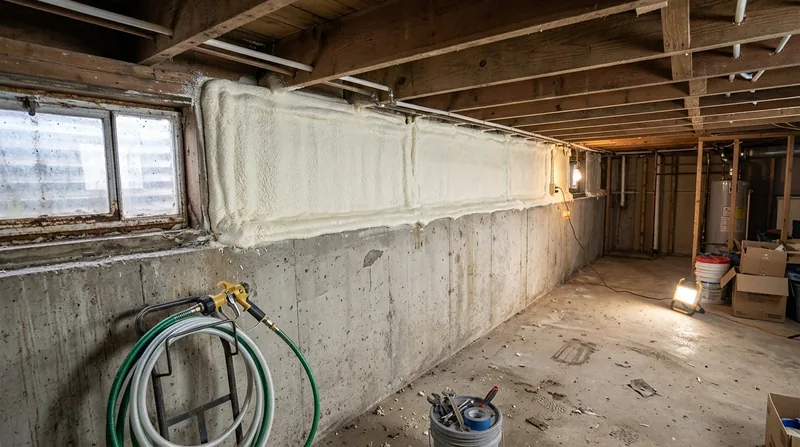




The rim and band joist that sits atop your foundation wall is where heat escapes fastest in Waterloo winter. This wood ledge, exposed to the cold crawlspace or basement below, leaks more energy than most homeowners realize, and the long heating season that dominates the Cedar Valley pushes moisture outward through every gap. Rim joist and band joist spray foam seals this weak point with a continuous air barrier and insulation that stops both the draft and the moisture migration that can rot the rim board itself. Homes built in the early 1900s along the Cedar River, postwar ranches scattered across the city, and newer construction in Cedar Falls and Hudson all share this same vulnerability, and all benefit from the same fix. We've been sealing rim joists and band joists across Waterloo and Black Hawk County since 2015, and the work pays for itself in reduced heating bills within a few years. If your basement stays cold or your heating bill climbs every December, your rim joist is likely the culprit.
Why Rim Joist and Band Joist Insulation Matters in Waterloo's Climate
Waterloo sits in IECC climate zone 6A, a cold-winter region where the heating season stretches from October through April and often into May. That long stretch of below-freezing temperatures creates steady outward vapor drive: warm, moist air from your living space moves toward the cold rim joist, and if that rim joist is not sealed and insulated, moisture reaches dew point inside the wood and begins to condense. Over years, this cycle rots the rim board and degrades the sill plate connection, weakening the structural bond between your house and foundation. The rim joist is also the thermal bridge that connects your heated interior directly to the cold basement or crawlspace below. A typical uninsulated rim joist loses as much heat per linear foot as an uninsulated attic loses per square foot, making it one of the highest-return targets for insulation retrofit in any Waterloo home.
- An uninsulated rim joist accounts for 10 to 20 percent of total basement heat loss in a typical Waterloo home.
- The long heating season pushes moisture outward continuously, rotting exposed wood if the air barrier fails.
- Spray foam creates a continuous seal that stops both air leakage and vapor transmission at the rim.
- Sealing the rim joist also reduces noise transmission between basement and main living areas.
This combination of heat loss and moisture risk makes rim joist sealing one of the most cost-effective insulation upgrades in the region.
Key info: A basement in Waterloo or Cedar Falls that stays cold year-round, despite heating, often signals a leaking rim joist. Blower door testing reveals the air leakage; visual inspection shows where moisture has already begun to stain or soften the wood.
For more on moisture and air sealing across your home, see our air sealing services.
How We Seal and Foam Your Rim Joist in Waterloo
Rim joist spray foam work starts with a site assessment to understand the rim board condition, the rim height (how much linear footage needs foam), and what sits behind the rim (basement, crawlspace, or vented rim joist cavity). We remove any existing fiberglass or loose insulation, inspect for rot or moisture damage, and confirm the substrate is clean and dry before any foam goes down. If the rim is wet or shows active decay, we stop and refer you to a water management or structural specialist, because foam over a wet substrate fails and traps the moisture problem inside the foam. Once the rim is dry and clean, we apply spray foam in controlled passes, building to the target R-value and thickness specified in our written estimate.
- We inspect the rim joist and band board for moisture, rot, and existing insulation condition.
- We remove old fiberglass or failed insulation and vacuum the rim cavity clean.
- We verify the rim board is dry and confirm the substrate temperature and humidity are in range for foam application.
- We apply closed-cell or open-cell spray foam in multiple controlled passes to reach the specified R-value and thickness.
- We allow the foam to cure fully (24 to 48 hours) before the rim joist is re-entered or covered.
- We clean up debris and provide a written record of thickness, R-value, and material used.
The entire process typically takes one to two days depending on the linear footage of rim joist and the complexity of access.
Example: A Waterloo home with 120 linear feet of rim joist (typical for a full basement under a 1.5-story house) takes one day to prep and foam, with a second day for cure before the basement is fully occupied again. A smaller 60-foot rim in a Hudson or Evansdale ranch is often completed in a single work day.
If your rim joist is part of a larger air sealing project, such as attic insulation or crawl space foam, we sequence the work to minimize disruption and maximize the overall air barrier benefit.
Rim Joist Foam Methods: Closed Cell vs. Open Cell
| Approach | Description | Best for |
|---|---|---|
| Closed-cell spray foam | Dense, rigid foam with R-value of 6 to 7 per inch; acts as both air barrier and vapor barrier; resists moisture and rot. | Rim joists in basements with history of moisture or condensation; crawlspace rims; areas where vapor control is critical. |
| Open-cell spray foam | Lighter, softer foam with R-value of 3.5 to 4 per inch; air barrier but not vapor barrier; allows drying to interior. | Rim joists in heated basements where vapor can dry inward; new construction rim cavities; cost-sensitive retrofits on dry rims. |
| Closed-cell, thin pass (2 inch) | Minimum 2-inch layer of closed-cell foam providing R-12 to R-14 and full vapor control; typical retrofit thickness. | Most Waterloo and Cedar Falls rim joist retrofits; balances performance, cost, and structural depth without excessive foam. |
| Open-cell, thicker pass (4 to 6 inch) | 4 to 6 inches of open-cell foam providing R-14 to R-24; less cost per R-value than closed-cell but requires vapor management. | Rim cavities with depth; basements where interior drying is possible; new construction rim assembly in climate zone 6A. |
The choice between closed-cell and open-cell depends on the rim joist cavity depth, the history of moisture in the basement, and whether vapor control or cost is the priority. In Waterloo's cold climate, closed-cell is the safer choice for retrofit work because it stops both air and vapor, preventing condensation. Open-cell works well in new construction where the rim cavity is deep and the basement is heated and dry.
Rim Joist and Band Joist Spray Foam Cost in Waterloo: What to Expect
The cost of rim joist foam insulation in Waterloo depends on three main factors: the linear footage of rim joist to be sealed, whether the rim is currently insulated (removal adds labor), and the foam type and thickness you choose. Most Waterloo homes have between 80 and 150 linear feet of rim joist, and a typical retrofit with 2 inches of closed-cell foam runs from $650 to $1,500 depending on the size and complexity of access. A larger home with 150+ linear feet or a rim with difficult access (tight crawlspace, multiple rim sections) can cost $1,500 to $2,500. Removal of old fiberglass or failed foam adds $200 to $400 to the total. Open-cell foam is typically 20 to 30 percent cheaper per board foot than closed-cell, so a thicker open-cell retrofit may cost less upfront but requires more careful vapor management.
The best way to know the exact cost for your rim joist is to request a free, no-obligation written estimate. We visit your home, measure the rim, assess the condition, and provide a detailed quote that includes the R-value, thickness, and material type, so you know exactly what you are paying for. We also recommend getting estimates from at least two other contractors in Waterloo or Hudson, because spray foam pricing varies widely based on equipment, crew experience, and overhead. See our pricing page for more detail on what factors move the cost up or down.
Rim Joist and Band Joist Spray Foam Near Me: What Waterloo Homeowners Should Know When Hiring
When you are ready to hire a spray foam contractor for your rim joist in Waterloo, Hudson, Cedar Falls, or any town in the area, there are several things to verify before you sign. First, confirm that the contractor is fully insured and can provide a current certificate of insurance; this protects you if something goes wrong during the work. Second, ask for a written estimate that includes the R-value, thickness, and board footage of foam, plus the material cost and labor cost itemized. Do not hire based on a price quote alone; a contractor who cannot or will not specify R-value and thickness is cutting corners. Third, ask for references from recent rim joist or basement foam jobs in Waterloo or nearby, and call at least two of them to ask about the quality of the work and the professionalism of the crew. Fourth, verify that the contractor understands local building code and permitting for spray foam work at your address; in Waterloo, thermal barrier and ignition barrier requirements are governed by the local building official, and the contractor should be able to explain what applies to your home. Fifth, if you have an HOA or architectural review board (common in newer subdivisions in Cedar Falls or Evansdale), confirm that the contractor is aware of any rules that may apply to insulation work on your property.
- Request a written estimate with R-value, thickness, and board footage clearly stated, not just a total price.
- Confirm the contractor is fully insured and provides a current certificate of insurance before work begins.
- Ask for at least two references from rim joist or basement foam jobs completed in the last 12 months in Waterloo or nearby.
- Verify the contractor understands the thermal barrier and ignition barrier requirements that apply to spray foam in your city or town.
- Discuss the timeline for cure and re-entry, and confirm that mechanical ventilation will be provided during application.
If you have questions about what applies at your address or want to verify a contractor's qualifications, contact us at (319) 349-2560 or request a free estimate online.
Rim Joist & Band Joist Spray Foam in Waterloo: Pricing Guide
| Service | Price | Details |
|---|---|---|
| Rim joist foam retrofit, 80 to 120 linear feet | Starting at $650 | 2 inches of closed-cell foam, typical Waterloo basement, includes prep and cleanup |
| Rim joist foam retrofit, 120 to 150+ linear feet | Starting at $1,200 | 2 inches of closed-cell foam, larger basement or multiple rim sections, material and labor |
| Rim joist foam with removal of old insulation | Add $200 to $400 | Labor to remove failed fiberglass or previous foam before new foam is applied |
| Complex or difficult-access rim joist | On estimate | Tight crawlspace, multiple rim levels, or structural obstacles require site visit for accurate pricing |
| Travel and free estimate | Included | No mileage charge in Waterloo, Cedar Falls, Evansdale, Hudson, and surrounding Black Hawk County |
Indicative pricing, the exact cost depends on square footage, finish, and site access. Free personalized estimate within 24h at (319) 349-2560.


