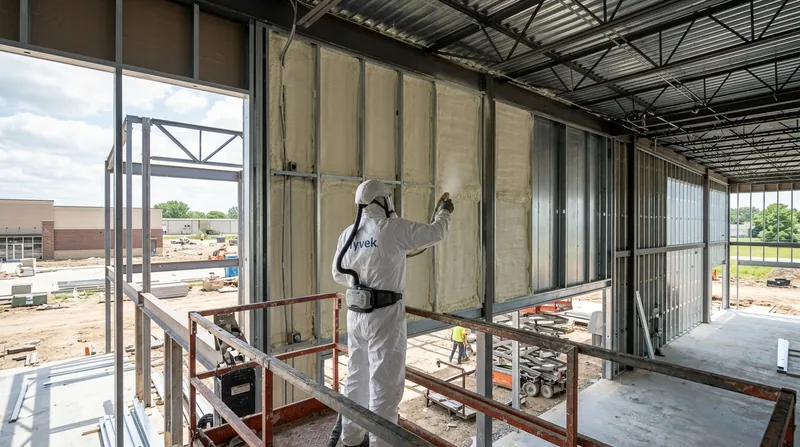




Commercial & New Construction Spray Foam in Waterloo builds the air barrier that zone 6A winters demand. Waterloo's new construction spans Cedar Falls, Evansdale, Hudson and Raymond, with two-story homes, offices, shops and mixed-use buildings that need a continuous thermal and air barrier before the first hard freeze. The Cedar Valley's long heating season, heavy snow, and wind-driven moisture make the difference between a building that holds temperature and one that bleeds heat through every gap. We provide spray foam insulation and air sealing for new commercial shells, office fit-outs, retail spaces and residential construction across Black Hawk and Bremer counties. Our scope is measured before work begins, estimated in writing with R-value and thickness specifications, and completed with mechanical ventilation during cure and a clear re-entry window.
Why New Construction Spray Foam Matters in Waterloo and Cedar Falls
New builds in the Waterloo area are designed to code, but code is a floor, not a ceiling. A sealed attic or roof deck keeps winter moisture from reaching the cold underside of sheathing, where it condenses and rots framing over five to ten years. Rooms over garages, cathedral ceilings, and open-concept layouts all create thermal bridges and air leakage paths that blown-in insulation cannot seal. Spray foam creates a continuous barrier at the thermal envelope, stops air movement before it starts, and gives builders confidence that the structure will perform as designed through its first decade and beyond.
- Sealed attics and roof decks prevent moisture intrusion in zone 6A's cold winters and keep the attic dry year-round.
- Spray foam adheres to wood, steel, concrete and irregular surfaces, sealing gaps that fiberglass cannot reach.
- Closed cell foam resists moisture and provides structural strength on metal buildings and barndominiums across the Cedar Valley.
- Open cell foam offers sound dampening and lower cost for interior walls and attics in residential new construction near Cedar Falls and Hudson.
- Air sealing around penetrations, rim joists and band joists stops thermal bridging before the building envelope is closed.
The result is a building that meets code, holds its rated R-value, and does not require remedial air sealing five years after occupancy.
Local example: A new two-story home in Evansdale with a cathedral ceiling and a garage below requires closed cell foam in the roof deck to prevent moisture from collecting under the sheathing. Open cell alone will absorb condensation and fail. The builder gets a written specification, the homeowner gets a dry attic, and the inspector sees a continuous air barrier that passes the blower door test on the first try.
For more on how sealed attics perform, see our attic spray foam insulation page. For permitting questions specific to your city, contact the local building department; the Waterloo Cedar Falls area chamber can point you to the right office.
How We Scope and Install Commercial & New Construction Spray Foam in Waterloo
New construction is measured before the first board is cut. We walk the frame, identify thermal breaks, air leakage points, and moisture risk zones, then provide a written estimate with R-value, thickness, board footage and the foam type (closed cell or open cell) that the building design requires. Installation happens after framing and before drywall, with mechanical ventilation running during cure and a forty-eight-hour re-entry window before occupancy or interior work resumes.
- Schedule a site visit during framing; bring the plans and any energy code compliance documents.
- We measure the attic, roof deck, rim joists, walls and any sealed cavities that need foam.
- We provide a written estimate with R-value, thickness and board footage for each zone.
- We confirm the foam type (closed cell for moisture-critical zones, open cell for cost-effective interior cavities) and any thermal barrier requirements under code.
- Installation is scheduled after framing, with mechanical ventilation and a clear re-entry protocol.
- We inspect thickness and continuity before drywall, and provide documentation for the builder and inspector.
This approach means no surprises, no rework, and no argument with the inspector about whether the foam meets code.
Waterloo example: A new office building in downtown Waterloo has a metal roof deck and a sealed attic for mechanical equipment. Closed cell foam, two inches thick, stops condensation from forming on the underside of the metal, meets the thermal barrier requirement with a fire-rated coating, and is fully documented before the roof membrane is installed. The building passes the blower door test and requires no remedial sealing.
Learn more about closed cell spray foam and its use in commercial and metal building applications. For air sealing around mechanical penetrations and ductwork, see our air sealing service.
Spray Foam Methods for New Construction: Closed Cell, Open Cell and Hybrid Approaches
| Approach | Description | Best for |
|---|---|---|
| Closed Cell Spray Foam | High-density foam, 1.5 to 2 lb/ft3, R-6 to R-7 per inch, vapor-impermeable, resists moisture and provides structural strength on metal and concrete substrates. | Metal building roof decks, sealed attics in zone 6A, rim joists, basements, and any cavity where moisture risk is high or structural support is needed. |
| Open Cell Spray Foam | Low-density foam, 0.4 to 0.5 lb/ft3, R-3.5 per inch, vapor-permeable, absorbs sound, lower cost, and allows walls to dry if moisture enters. | Attics in dry climates, interior wall cavities, sound dampening in offices and retail, and residential attics where cost is the priority and moisture risk is low. |
| Hybrid (Closed Cell Base, Open Cell Top) | Two inches of closed cell for air sealing and moisture control, topped with open cell for cost and sound dampening in the same cavity. | Cathedral ceilings, attics with mixed risk, and retrofit attics where budget and performance must balance. |
| Air Sealing with Closed Cell Spot Foam | One-inch closed cell at rim joists, band joists, and around penetrations; fiberglass or blown-in cellulose fills the rest. | Budget-conscious new construction, rim joist sealing in basements, and buildings where spray foam is used surgically at the highest-risk points. |
Each method is chosen based on the building's location, moisture profile, structural needs and budget. We specify in writing before any foam is ordered.
Commercial & New Construction Spray Foam Cost in Waterloo: What to Expect
New construction spray foam is priced by the board foot, measured on site and confirmed in a written estimate before work begins. A typical new residential home in the Waterloo area (attic, rim joists, and sealed cavities) runs 400 to 800 board feet; a commercial shell or office fit-out can range from 500 to 3,000 board feet depending on the footprint and ceiling height. Cost per board foot varies by foam type, thickness, and complexity of access, but a free commercial estimate is the only honest starting point.
Factors that move the price include the R-value required by code (zone 6A typically calls for R-38 to R-49 in attics), whether the substrate is wood, steel, concrete or irregular, the need for a thermal barrier or fire-rated coating, and the logistics of accessing the space during construction. A two-story home with a sealed cathedral ceiling costs more per board foot than a single-story office with a flat roof because the spray crew works at height and must maintain safety protocols.
Get a free estimate from us at (319) 349-2560. We will measure the space, confirm the foam type and thickness with the builder and building code, and provide a firm price in writing. For a detailed pricing overview across all our services, see our full pricing page.
What to Look for When Hiring a Spray Foam Contractor Near Waterloo
New construction is not the place to cut corners on insulation. A spray foam contractor working in Waterloo, Cedar Falls, Evansdale or Hudson should provide a written estimate with R-value and thickness before any work begins, confirm that the foam type and installation method meet the local building code, and carry full insurance that covers spray foam work and liability. Many contractors will estimate over the phone or from photos; a legitimate spray foam shop will measure on site and walk the frame with the builder or homeowner.
Ask for references from builders or commercial clients in the area, verify that the contractor's insurance is current and covers spray foam application, and confirm that permits and inspections are handled by the builder or owner (not the foam contractor, unless explicitly agreed). Check the local building department website for any required contractor registration in your city; requirements vary across Black Hawk and Bremer counties, and there is no reciprocity between cities. If the estimate is unusually low, includes no R-value or thickness specification, or promises immediate re-entry without mechanical ventilation, that is a signal to call another contractor.
For a no-obligation estimate and references from Waterloo-area builders, contact us or call (319) 349-2560. We are fully insured, provide written estimates with all specifications, and work with builders and commercial clients across the Cedar Valley.
Commercial & New Construction Spray Foam in Waterloo: Pricing Guide
| Service | Price | Details |
|---|---|---|
| Free commercial estimate | Free | On-site measurement, R-value and thickness specification, board footage calculation, no obligation to book |
| Closed cell spray foam (new construction) | Starting at $1.25/board foot | Includes material, labor, mechanical ventilation during cure, thermal barrier where code requires, and forty-eight-hour re-entry window |
| Open cell spray foam (attics and interior walls) | Starting at $0.85/board foot | Lower cost than closed cell, includes labor and ventilation, best for dry attics and sound dampening in residential new construction |
| Hybrid or spot-foam approach | On estimate | Closed cell at rim joists and high-risk zones, open cell or blown-in elsewhere; priced after site measurement and code review |
| Travel and mobilization | Included | No separate charge for Waterloo, Cedar Falls, Evansdale, Hudson and surrounding service areas within Black Hawk and Bremer counties |
Indicative pricing, the exact cost depends on square footage, finish, and site access. Free personalized estimate within 24h at (319) 349-2560.


