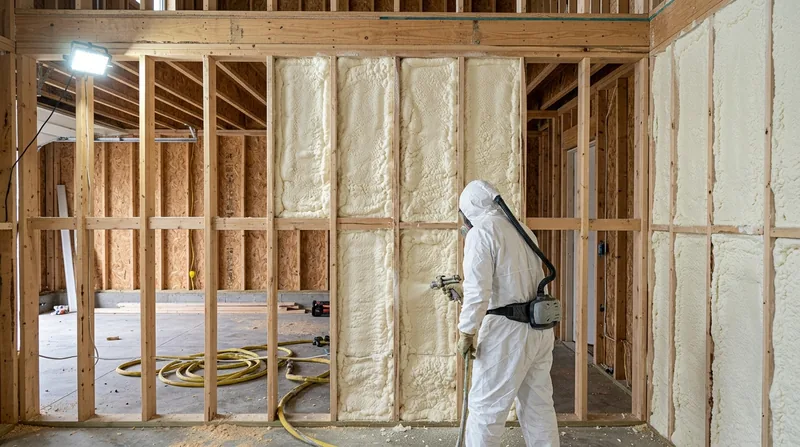




Open cell spray foam insulation in Waterloo fills the gaps that balloon-framed walls in older neighborhoods along the Cedar River leave open all winter long. The homes built before 1950 that dominate east and central Waterloo, plus the postwar ranches scattered across the city and the newer two-story construction in Cedar Falls, Evansdale, and Hudson, all lose heat through air leaks that fiberglass and blown-in insulation cannot seal. Open cell foam expands to fill every void in walls, rim joists, and interior cavities, stopping the cold air that drafts through gaps and around framing members. In climate zone 6A, where the heating season stretches from October through April and winter wind drives moisture outward from living space into cold walls and attics, a continuous air barrier is not a luxury, it is the foundation of an energy-efficient home. We spray open cell foam on interior walls in older homes, on rooms over garages in newer construction, and in wall cavities where closed cell is overkill and budget matters. The result is warmer rooms, lower heating bills, and a home that stays comfortable through the long Waterloo winter.
Why Open Cell Spray Foam Insulation Matters in Older Waterloo Homes
Balloon-framed houses built in the early 1900s in neighborhoods near the Cedar River have no firestop between floor joists, and the rim and band joists that sit on the foundation are often uninsulated and open to the basement. Postwar ranches have vented attics with thin insulation that has settled over seventy years, and gaps around rim joists where the foundation meets the sill plate. Newer homes in Cedar Falls and Hudson add rooms over garages and unfinished spaces where heat loss through walls and ceilings costs money every month. Open cell foam seals these gaps permanently. Unlike blown-in fiberglass, which leaves voids around framing and pipes, open cell expands to fill every corner, creating a true air barrier that stops infiltration.
- We inject open cell foam into closed wall cavities of older homes without removing drywall or siding, sealing air leaks that drafts through rim joists and band joists.
- We spray open cell in unfinished basement walls and rim joists to stop cold air from rising into living spaces above.
- We apply open cell in interior walls of rooms over garages, creating a thermal and acoustic barrier between conditioned and unconditioned space.
- We fill attic cavities and rafter bays with open cell when the attic is not vented and insulation is the only tool needed.
Each of these applications stops the air leakage that a blower door test will expose in a Waterloo home, and each one cuts heating costs through the winter season when energy demand peaks.
Key info: A 1920s home on Mulberry Hill in Waterloo with balloon framing and a cold basement lost heat through rim joists and through gaps in the wall cavity above the foundation. Open cell foam injected into the wall cavity and sprayed on the rim joist sealed both air leaks in a single job, and the homeowner reported noticeably warmer first-floor rooms and a heating bill drop of about 18 percent in the following winter.
For more context on how spray foam seals the specific weak points of Waterloo homes, see our page on rim joist and band joist spray foam insulation.
How We Install Open Cell Spray Foam Insulation in Waterloo
Open cell foam is sprayed from a portable rig that heats the resin and catalyst to the manufacturer's temperature, mixes them at the correct ratio, and delivers the material through a hose to the applicator's gun. The foam expands to roughly three times its initial volume, filling every gap in the cavity. We control the thickness on each pass to meet the R-value and coverage your home needs. The installation takes hours, not days, and the foam cures over twenty-four to forty-eight hours, during which the space must have mechanical ventilation running to clear VOC vapors. After cure, the foam is stable and ready for drywall or other finish.
- We drill small access holes in drywall or exterior walls to reach the cavity, keeping the disturbance to a minimum and patching afterward.
- We set up a portable spray rig on site, manage the hose runs, and position the applicator to fill the cavity from bottom to top in controlled passes.
- We run mechanical ventilation during cure to exhaust VOC vapors and ensure a safe re-entry window of twenty-four to forty-eight hours.
- We measure the thickness and density on each pass to confirm R-value and coverage match the estimate and the building code for your address.
The result is a continuous air barrier with no voids, no settled gaps, and no drafts through the wall cavity.
Example: A 1960s ranch in Hudson with a room over an unheated garage had single-pane windows and thin insulation in the walls above the garage. The room was always cold in winter. We drilled access holes in the interior wall, sprayed open cell foam into the cavity to R-21, and patched the holes. The room stayed warm all winter, and the homeowner sealed the windows the following summer. Total project cost was less than closed cell foam would have been, and the acoustic benefit of the foam reduced garage noise into the room as well.
For more detail on how spray foam and air sealing work together, see our page on air sealing in Waterloo homes.
Open Cell Spray Foam Methods and Applications
| Method | Description | Best for |
|---|---|---|
| Injection into closed cavities | Small access holes drilled in drywall or siding, foam injected into the cavity between studs or joists, holes patched after cure. | Older Waterloo homes with balloon framing, retrofits without demolition, rim joists, and band joists. |
| Spray on open framing | Foam sprayed directly on exposed studs, joists, and sheathing before drywall is hung, filling every void and creating a continuous barrier. | New construction, additions, rooms over garages, and unfinished basements before finish work. |
| Attic cavity fill | Open cell sprayed into rafter bays and attic cavities to fill voids and create a sealed, insulated envelope under the roof deck. | Unvented attics, sealed roof decks, and attic spaces where venting is not required and insulation is the primary control. |
| Interior wall sealing | Open cell foam applied in interior walls between conditioned and unconditioned space, such as between a finished room and a garage or exterior wall. | Rooms over garages, basements, and interior walls where thermal and acoustic performance are both important. |
| Rim joist and sill sealing | Open cell sprayed directly on exposed rim and band joists at the foundation, filling the gap between the sill plate and the foundation and sealing the joist cavity. | Full basements in Waterloo homes, cold basements, and cold floors on first stories above uninsulated foundations. |
Each method is chosen based on the cavity type, the finish state of the wall, and the R-value target for your home. Open cell is cost-effective for interior applications and retrofit work where access is tight and budget is a priority.
Open Cell Spray Foam Insulation Cost in Waterloo: What to Expect
Open cell spray foam typically costs starting at $0.55 per board foot, which is less than closed cell foam but more than blown-in fiberglass. A board foot is one foot by one foot by one inch thick. A typical wall cavity retrofit might use 40 to 80 board feet, depending on the cavity depth and the R-value target. A rim joist job on a full basement might run 100 to 200 board feet. The final cost depends on the size of the cavity, the R-value you need, the access difficulty, and whether the substrate is clean and dry before we spray. If we find moisture, mold, or contamination, we stop and refer you to the right specialist, because foam does not fix a wet substrate. We do not spray over leaks or standing water.
Several factors move the price up or down. A small injection job in a single wall cavity costs less than a large attic retrofit. Access difficulty, such as crawling through a cramped basement to reach rim joists, adds time and may increase the cost. The R-value you choose matters: R-13 takes less material than R-21. Travel time is included in Waterloo and the surrounding service area, so no mileage fee applies. We provide a written estimate with the R-value, thickness in inches, and board-foot count, so you know exactly what you are paying for before we start.
The best way to understand cost for your home is to request a free estimate. We will visit, assess the cavities, discuss your goals, and provide a firm quote with all the details. Comparing two or three estimates is smart, because you want to verify that the contractor is specifying R-value and thickness, not just a price per square foot. A low bid with no R-value spec is a red flag.
For a more complete pricing overview, see our pricing page.
Open Cell Spray Foam Insulation Near Me: What to Look for When Hiring a Contractor in Waterloo
Hiring a spray foam contractor is a decision that affects your home's comfort and energy use for decades, so it is worth taking time to verify credentials and understand the scope. The spray foam trade includes local shops that know Waterloo homes, national franchises with crews that travel state to state, and rig-and-run operators who spray a job in an afternoon and are unreachable if problems arise. The local independent contractor is positioned to provide honest guidance, and the way to verify that is to ask the right questions and check the answers.
Start by verifying that the contractor is fully insured and can provide a certificate of insurance. Ask for references from Waterloo-area jobs completed in the last two years, and call at least two. Ask the reference about the quality of the install, whether the contractor showed up on time, whether the estimate was accurate, and whether they were responsive if any issues came up after the job. Ask the contractor whether they pull permits or help you navigate what applies at your address. Permits for spray foam vary by city in Greater Waterloo, so the contractor should know the local rules or should defer to the building department on your behalf. If you have an HOA or architectural review board, confirm that exterior work will not trigger a review. If your home has a protected tree or is in a heritage district, ask the contractor how they will manage the work to keep the site safe.
Do not hire based on price alone. A bid that is far below market, with no R-value spec and no clear scope, is a warning. The lowest price often means the shortest job, the least ventilation during cure, and the most risk of a bad smell or off-gassing afterward. Get multiple estimates, but compare them on the same terms: R-value, thickness, board feet, and scope. Ask each contractor to explain why their approach is right for your home, not just what it costs.
When you are ready to move forward, contact us at (319) 349-2560 for a free estimate. We will visit your home, assess the work, and provide a written estimate with all the details you need to make an informed decision.
Open Cell Spray Foam Insulation in Waterloo: Pricing Guide
| Service | Price | Details |
|---|---|---|
| Interior wall cavity injection | Starting at $0.55/board ft | Includes access holes, foam application, patching, and ventilation during cure for retrofit work |
| Rim joist and band joist sealing | Starting at $0.55/board ft | Covers exposed or accessible rim joists, sill plates, and the cavity above the foundation in full basements |
| Attic or rafter bay fill | Starting at $0.55/board ft | Applied to open framing before drywall or in unvented attics, with R-value and thickness specified in writing |
| Complex retrofit or large cavity | On estimate | Multi-cavity jobs, moisture or contamination remediation first, or difficult access require site visit and written scope |
| Travel and estimate | Included and free | No mileage fee in Waterloo and service areas, free written estimate with R-value and thickness specifications |
Indicative pricing, the exact cost depends on square footage, finish, and site access. Free personalized estimate within 24h at (319) 349-2560.


