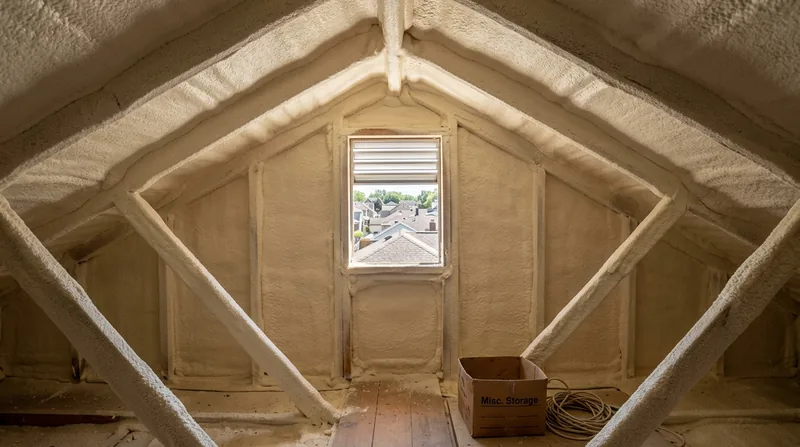




Attic spray foam insulation in Waterloo addresses the core energy problem of the Cedar Valley: moisture migration from heated living space into cold roof decks during zone 6A winters, and the air leakage that drives it. Waterloo's housing stock spans early-1900s balloon-frame homes along the Cedar River, postwar ranches with vented attics and thin settled insulation, and newer two-story construction in Cedar Falls, Evansdale, and Hudson. All three eras lose heat and gain moisture through the attic plane. We seal the air barrier and install spray foam insulation across Waterloo attics, stopping that drift before it reaches dew point and before winter heating bills climb further. The long heating season here, stretching from October through April, makes a continuous, sealed attic the single highest-return investment a homeowner can make.
Why Attic Spray Foam Insulation Matters in Waterloo's Climate
Waterloo sits in IECC climate zone 6A, where winters are long and brutal and the heating season dominates the energy bill. The Cedar River neighborhoods house early-1900s homes with balloon-framed walls, uninsulated rim joists, and vented attics that leak heat all winter. Postwar ranches scattered across the city carry vented attics with thin, settled fiberglass and ductwork that passes heat straight through the ceiling plane into the unconditioned attic above. Newer homes in Cedar Falls and Hudson add rooms over garages and uninsulated garage spaces that swing wide in temperature. In all three eras, warm interior air meets cold attic space, moisture drifts outward, and if the air barrier fails, that moisture reaches dew point and condenses on framing and roof sheathing. Spray foam seals the air barrier at the attic plane and adds insulation value in a single pass.
- We seal air leaks at the rim joist, around ductwork penetrations, and at the band board where the attic meets the exterior wall.
- We install closed cell or open cell foam to the roof deck, creating a continuous thermal and air barrier that stops moisture drift.
- We work across vented attics, sealed roof decks, and attics with existing insulation that needs removal and replacement.
- We specify R-value and thickness on every estimate, so you know exactly what you are paying for and what the code requires at your address.
A sealed attic stops the heat loss that drives winter heating bills and prevents the moisture accumulation that leads to mold and wood rot on roof framing.
Key info: A postwar ranch in Waterloo with a vented attic, thin settled insulation, and no air sealing loses 25 to 40 percent of heating energy through the ceiling plane. Spray foam insulation and air sealing at the rim joist and ductwork penetrations recover much of that loss in the first heating season.
For more detail on how moisture and air leakage work in sealed attics, see our guide to closed cell spray foam insulation, which is the standard choice for attic sealing in zone 6A climates.
How We Install Attic Spray Foam Insulation in Waterloo: The Process
Attic spray foam insulation begins with a site visit and a clear scope: we measure the attic floor, identify air leaks and existing insulation condition, and determine whether the attic will be sealed (foam to the roof deck) or vented (foam to the rim joist and band board only). In Waterloo's older homes, rim joists and band boards are almost always uninsulated and are the first place we work. We then discuss R-value, foam type (closed cell or open cell), and any removal or replacement needed. Once the scope is set, we schedule the work, protect the living space below with plastic sheeting, and bring in our spray rig. We spray foam in controlled passes, maintaining the manufacturer ratio and drum temperature, and ensure mechanical ventilation during cure. Re-entry to the attic is safe after 24 to 48 hours, depending on conditions and foam type.
- We inspect the attic, identify air leaks, and measure the floor area and roof deck dimensions.
- We determine whether the attic will be sealed to the roof deck or remain vented with foam at the rim joist.
- We remove any failed insulation or contaminated material and dispose of it responsibly.
- We protect the interior of the home with plastic sheeting and tape before foam application begins.
- We spray foam in multiple passes, controlling thickness and allowing proper cure time between passes.
- We provide a written estimate with R-value and thickness specifications before any work begins.
The entire process from estimate to completion typically takes one to two weeks, depending on attic size and any removal work required.
Example: A 1,500-square-foot attic in a Waterloo postwar ranch with vented roof and settled fiberglass takes one day to remove old insulation, one day to spray foam the rim joist and band board, and one day to spray the roof deck to R-38. The homeowner stays out of the attic for 48 hours while the foam cures. We provide a written report with thickness and R-value measurements at completion.
For homes with crawl spaces or uninsulated rim joists below, we often combine attic work with rim joist and band joist spray foam to maximize the thermal envelope in a single project.
Attic Spray Foam Insulation Methods: Sealed Deck vs. Vented Attic
| Approach | Description | Best for |
|---|---|---|
| Sealed roof deck (closed cell foam) | Foam sprayed directly to the underside of the roof sheathing, creating an unvented attic. The attic becomes part of the conditioned space. HVAC ducts and equipment in the attic no longer lose heat to unconditioned air. | Newer homes with ducts in the attic, homes where adding insulation depth is difficult, and any home where condensation on roof framing is a concern. |
| Vented attic with rim foam (open or closed cell) | Foam applied to the rim joist, band board, and attic floor perimeter, leaving the roof deck vented to the outdoors. The attic itself remains unconditioned but the thermal boundary is at the ceiling plane. | Postwar and older Waterloo homes where the roof is sound, attics are used for storage, and roof ventilation is desired to manage moisture. |
| Attic floor with open cell foam | Open cell foam sprayed over the attic floor joists to R-38 or R-49, with the roof deck left vented. Open cell is lower density, lower cost per board foot, and allows any moisture that does enter the attic to dry back into the living space. | Attics with no ducts or equipment, where cost is a primary concern, and where venting the roof is the best moisture management strategy. |
| Removal and re-insulation (mixed methods) | Old or failed insulation removed completely, air sealing applied to all penetrations and rim joists, new foam installed to the specified R-value. May combine closed cell at rim joists with open cell at the floor. | Any attic where existing insulation is settled, wet, contaminated, or inadequate, and where a fresh start is the most cost-effective path forward. |
Attic Spray Foam Insulation Cost in Waterloo: What to Expect
Attic spray foam insulation in Waterloo typically starts at $1.50 per square foot for open cell foam applied to the attic floor in a vented attic with no removal work. Closed cell foam to the roof deck or rim joist runs higher, usually $2.50 to $4.00 per square foot, because it is denser, carries higher R-value per inch, and requires more material and labor. A 1,500-square-foot attic with no removal and open cell foam to R-38 runs $2,250 to $2,700. The same attic sealed to the roof deck with closed cell foam runs $3,750 to $6,000. Removal of old insulation adds $0.50 to $1.00 per square foot, depending on what is there and how it is disposed of. Air sealing around ductwork, rim joists, and ceiling penetrations is included in the foam price; we do not charge separately for it.
Several factors move the price up or down: attic size (larger attics have a lower per-square-foot cost), existing insulation condition (if removal is needed, cost rises), roof deck access (tight attics or roofs with limited entry slow the work and increase labor), and the R-value target set by your local building code. Waterloo's building department may require R-38 minimum for attics; Cedar Falls and Hudson may require R-49 or higher depending on the year the home was built and the code in force at your address.
Always request a written estimate with R-value and thickness specifications before committing to any job. We provide free estimates within 24 hours at (319) 349-2560. For a detailed breakdown of pricing across all our services and a comparison of cost per method, visit our full pricing page.
What to Look for When Hiring a Spray Foam Insulation Contractor Near Waterloo
Hiring the right spray foam contractor is as important as the foam itself. The trade includes both local, accountable shops and out-of-state rig-and-run crews that spray a job in an afternoon and disappear when the smell will not go away or when the foam fails to cure properly. A good contractor is fully insured, provides written estimates with R-value and thickness clearly stated, and is reachable after the job is done. Always ask for references from recent attic jobs in Waterloo or nearby Cedar Falls and Hudson, and call them. Verify the contractor's insurance by requesting a certificate of insurance naming you as an additional insured. Ask whether the contractor will pull any permits required by your city; permitting rules vary from Waterloo to Cedar Falls to Hudson, and the contractor should know what applies at your address.
- Request a written estimate that specifies R-value, foam thickness in inches, and the total square footage being foamed.
- Ask the contractor to explain the difference between open cell and closed cell foam and why one is recommended for your attic.
- Verify that the contractor carries full insurance and ask for a certificate of insurance before any work begins.
- Check references from at least two recent attic jobs in your city or a nearby area.
- Ask about mechanical ventilation during the cure process and the re-entry window (typically 24 to 48 hours).
- Confirm that the contractor will address any air leaks at the rim joist, ductwork, and ceiling penetrations as part of the scope.
- Avoid any estimate with no R-value or thickness, a price far below market with no inspection, or a promise of immediate re-entry to the attic.
A local contractor with a local address and local plates, one who answers the phone and stands behind the work, is worth the conversation. Contact us at our contact page for a free, no-obligation estimate and to discuss which method is right for your home.
Attic Spray Foam Insulation in Waterloo: Pricing Guide
| Service | Price | Details |
|---|---|---|
| Open cell foam, attic floor, vented roof | Starting at $1.50/sq ft | Lowest cost option for vented attics with no ducts. Includes air sealing at rim joists and penetrations |
| Closed cell foam, sealed roof deck or rim joist | Starting at $2.50/sq ft | Higher density, higher R-value per inch. Best for attics with ducts or moisture risk. Includes all air sealing |
| Insulation removal and disposal | Starting at $0.50/sq ft | Cost varies by material type, depth, and whether removal is wet or contaminated. Separate quote on site |
| Large attic or sealed roof deck project | On estimate | Complex jobs, multiple methods, or attics over 2,000 sq ft require site measurement and written scope |
| Travel and service call | Included | No mileage fee or travel charge in Waterloo, Cedar Falls, Evansdale, Hudson, and surrounding areas |
| Free estimate | Free | Response within 24 hours at (319) 349-2560. No obligation to book. Written scope and price included |
Indicative pricing, the exact cost depends on square footage, finish, and site access. Free personalized estimate within 24h at (319) 349-2560.


